
Water Storage Tank Cleaning
Sediment settles out of well water, and it builds in the bottom of your tank for years before anyone looks. We get it out, and your water stays on for most of the job.
Call Now, Get a Quote, Schedule a Cleaning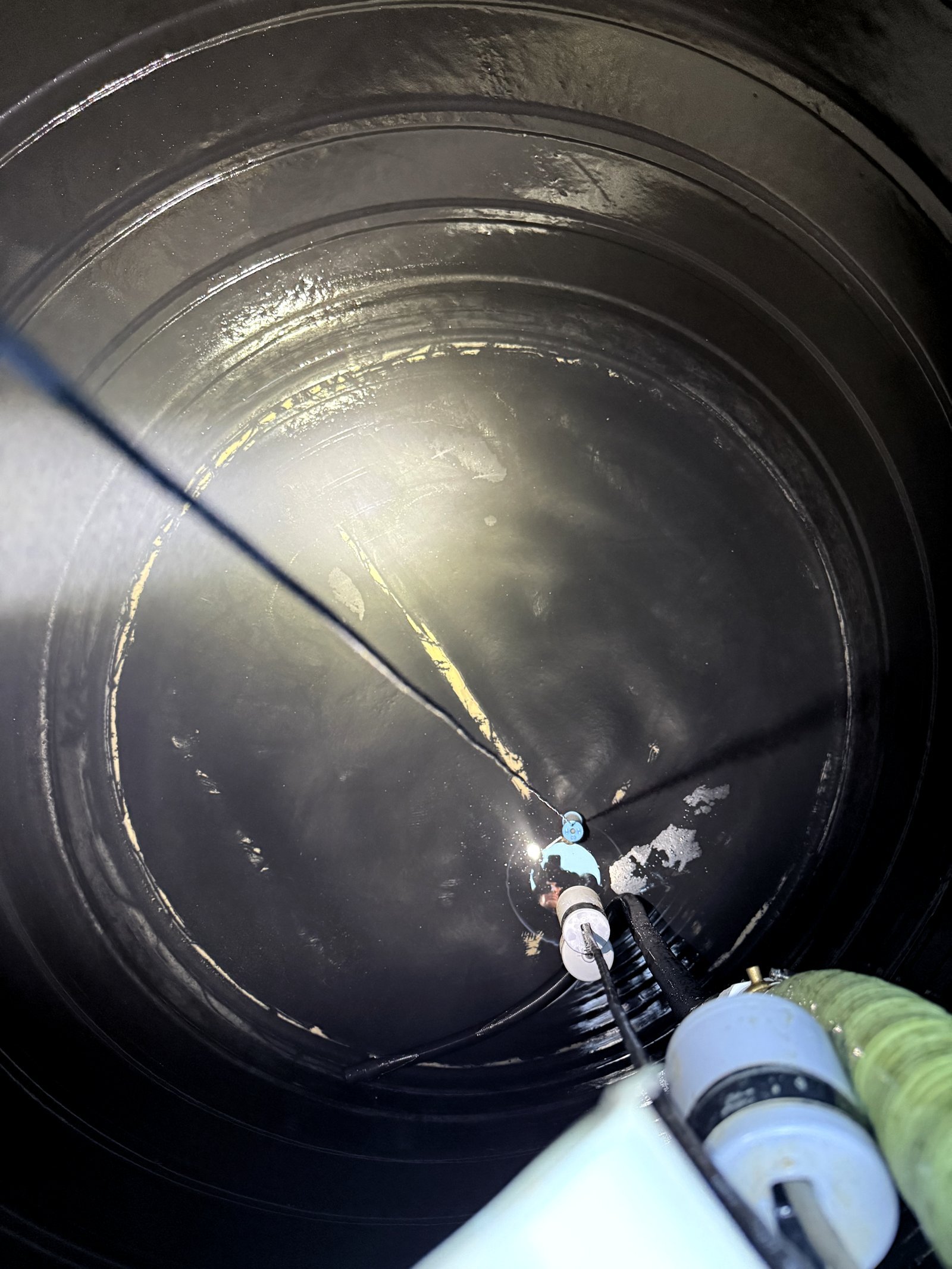
What's happening in your tank right now
Two paths, and only one of them is obvious.
Water comes out of your well carrying fine sand and silt. It lands in the tank, and from there it splits. Some settles to the bottom and stays. The rest keeps moving, out the outlet, through your filters, and into the house.
So two things are happening at the same time. Sediment is reaching your fixtures today, in water that barely paused in the tank. And a separate pile is building on the floor that nobody sees.
And the pile does not just sit there forever. The outlet on your tank is a few inches up off the floor, so for years the heavy material settles below it and stays put. Once the bed builds up to that outlet, it stops settling out and starts pouring in with the water.
How much is down there?
Every half inch of sediment across the floor of a 2,500 gallon tank is roughly 200 pounds of sand and silt.
Half an inch does not look like much when you are looking down into a tank from the lid. That is the problem – it never looks like much.
Sediment is not just sand
Here is the part most people have never been told, and it is the reason we take this seriously.
Once there is a layer of sediment on the floor of a tank, it stops being dirt and starts being habitat.
Research on drinking water systems is direct about this – sediment holds nutrients, and it shelters whatever settles into it. Federal research on drinking water systems states that sediments provide protection and nutrients, and that significant microbial activity can occur in accumulated sediment.
That growth has a name: Biofilm is the slick or slimy film you would feel if you ran a hand along the inside wall of a tank that has gone a while. It is not exotic and it is not a sign that anybody did anything wrong. Some amount of biofilm exists in essentially every water system in the country, municipal systems included.
What makes a storage tank different is that it is the friendliest place in your entire water system for it. The water sits still, and when it does move, it moves slowly. The sediment keeps building. That same federal research found the opportunities for biofilm development may be greater in storage tanks than in the pipes they feed.
And then there is the part that separates you from a house on city water.
Your water has never had a disinfectant in it
A city system puts chlorine in the water before it ever reaches a storage tank, and that residual keeps working the entire time the water sits there. It is not perfect, and the research above is largely about where it falls short. But it is continuous pressure against anything trying to grow.
Unless you are chlorinating your well, and most well owners are not, your tank has never had any of that. Nothing is suppressing growth between fills. Whatever makes it into your tank is in there, and it is in there under conditions that favor it.
That is not a knock on well water. Plenty of well water is excellent water, and no chlorine is one of the reasons people prefer it. But it does mean your tank is doing its job without a safety net, and the only thing standing between a clean tank and a tank that needs attention is somebody actually looking at it.
The two are one problem.
The sediment feeds the growth and hides it. That is why we remove the sediment physically instead of just adding a disinfectant, and it is why the cleaning is the service and the disinfection is the add-on rather than the other way around. Disinfectant cannot reach what is buried under a layer of silt.
What we can tell you, and what we can't
Published research on drinking water systems has found a range of organisms living in tank sediment and biofilm. Most are harmless. The studies have also documented bacteria like Salmonella and E. coli, mycobacteria, and parasites like Cryptosporidium surviving in biofilm or sediment.
What we cannot tell you is whether any of that is in your tank. We do not know, and most likely it is not.
The point is not that your water is dangerous. The point is that you do not know either, because nobody has looked in your tank and a standard water test does not check for most of this.
That is a solvable problem, and the rest of this page is how.
“We've been drinking this water for years and we're fine”
We hear this a lot, and it is a fair thing to say. If you have been on the same well for fifteen years and nobody has gotten sick, that is real information and we are not going to tell you to ignore it.
Here is the part worth sitting with.
Biological contamination is not steady. It is not like hardness or TDS, where the number is the number and it mostly stays put. It depends on conditions: what is in the sediment, how warm the water gets, how long it sits between draws, what got into the tank last spring, whether any visitors have been in the water.
Fifteen good years tell you that conditions have been fine for fifteen years. They do not tell you what happens when conditions change. And the thing about a storage tank is that conditions have been changing the whole time, slowly, in a direction nobody was watching.
Has anybody noticed all the growth coming up around us?
A lot of these well neighborhoods have been out here for decades, and for most of that time not much happened around them. That is not the situation anymore, and the conditions outside your tank have been changing right along with the ones inside it. Williamson County has been one of the fastest growing counties in the country for years now, and the counties around it are doing the same thing.
And many new rooftops out here come with a septic system of their own. More homes means more wastewater going into the same ground your well draws from, and more wells drawing from it.
Then there is everything built to serve those homes. Land that was pasture twenty years ago now holds shopping centers, fuel stations, service shops, equipment yards and warehouses, many of them running wastewater systems bigger than anything a house has. Pavement comes with all of it, which sends rainwater running off somewhere instead of soaking in where it falls. And the building itself means ground opened up, trenched and drilled across the whole county.
None of that is an accusation against anybody. It is just far more activity happening on top of the same ground your water comes out of, and almost none of it was there when your well was drilled.
That does not mean your water went bad. It means the ground your well sits in is not the ground it sat in twenty years ago. The experience you have built up over those years is real, and it was built under a different set of conditions than the ones you have now.
That is not a reason to panic. It is a reason to look.
How you'd actually know
Most of this you can check yourself, today, without calling anybody.
Look in the tank
That is the whole test, and it takes about two minutes. You are looking for two things:
- Sediment on the floor. A film is early. Anything you would call a layer is not.
- A slick or slimy film on the walls, particularly in the band where the water level rises and falls. That band is where growth concentrates, so it is the place to look first.
Open the lid carefully, and do not reach in or lower anything into it. That is your drinking water. A look costs nothing. Contaminating the tank with a dropped cell phone costs a cleaning.
The signs you can spot without climbing up there
- Sediment cartridges loading up faster than they used to
- Cloudiness, a tint, or grit at an aerator
- A taste or smell that is off, especially after the water has sat unused for a few hours
- Anything that got in: insects, a dead animal, recent work on the well
- A bacteria test that came back bad, or one that keeps coming back bad after you shocked the well
That last one deserves its own line. The standard advice for a well that keeps testing positive is to look for an ongoing source of contamination, and the usual suspects are a loose well cap, a cracked casing, or a septic problem. Those are the right places to start. But if you have chased all of that and the tests keep coming back, the storage tank is worth looking at, and it is the one thing nobody checks.
And if you want a number instead of a judgment call
Everything above is you looking; a coliform test is a lab telling you. Any state-certified lab will run one, it does not cost much, and there are several in the area that take samples from the public.
The catch is logistics. The bottle has to come from the lab, you can only pick one up during their hours, and the sample has to be back in their hands within 24 hours of when you draw it. That is two trips inside a narrow weekday window.
If that is the part standing in your way, ask us. We are already making that drive every month for our own compliance samples, so we can pull one while we are out and take it in with ours. It is an add-on rather than part of the cleaning.
Worth knowing either way: a clean test is good news about your water on the day it was drawn. It does not tell you what is sitting in the bottom of the tank. Which is why looking still matters.
See it for yourself
If your sediment filter has a clear housing, you already have a test you can run today.
Shut the water off and change the cartridge. Then watch the new one while you open the valve back up. On a tank carrying sediment, that white thread turns brown in seconds.
That is not old buildup washing loose. That is what is in your water right now.
What it costs you to wait
Set the biology aside for a minute, because the sediment does plenty on its own.
The cleaning is the cheap part. What it protects is not.
Sediment leaving your tank has to go somewhere, and it goes into:
- Your sediment filters, which clog well short of their rated life
- Your pump, pushing grit through itself every time it runs
- Your water heater, where it settles in the bottom and stays
- Your appliances, washing machine, dishwasher, ice maker, every fixture in the house
- Your softener and treatment system, which was sized for your water, not for silt
None of that arrives as a bill with the tank's name on it. That is exactly why it goes unnoticed. You replace filters a little sooner and a pump a little earlier, and you never connect it back to the tank.
The job itself also gets more expensive the longer it waits.
Heavy sediment takes longer to remove, and it is priced that way. A tank with a decade in it is not a base rate job… that is one more reason not to let yours get there.
What we do
Two services. Most tanks need the first. Some need both.
Tank Cleaning
from $645
We draw the tank down, vacuum the settled sediment off the floor, and wash the walls, with extra attention to the band at the waterline where growth concentrates. Then we rinse it out. Everything we pull out runs through our discharge hose, generally 25 to 50 feet from the tank, so it is worth thinking about where you want that water before we get there.
It is also the one time anybody gets a real look inside your tank. Most people have never seen the inside of theirs. We will tell you what we found, and whether we think it needs anything beyond a cleaning.
Price depends on tank size and how much has built up since the last cleaning.
Disinfection
add $150
A disinfectant only works on what it can reach, and it cannot reach what is buried under a layer of silt. That is why disinfecting a tank nobody has cleaned is mostly theater, and why we only do this on top of a cleaning rather than on its own.
We recommend it when there is a reason to: a water test came back bad, something got into the tank, there is a film on the walls, or you are tasting something or feeling something on your skin that sediment alone does not explain. Routine sediment on an otherwise healthy tank does not call for it, and we will tell you when we do not think you need it.
Filling it back up
Most choose to have us refill it - it is a separate decision from the cleaning, and we will talk it through while we quote the job.
We bring the water truck and fill the tank before we pull out. You are back in service within minutes, your well pump never sees the work, and the hauled water carries a disinfectant residual, which is worth something right after a cleaning when everything in the tank has been stirred up. That is the advantage of working with a water treatment company that also runs the trucks: the cleaning, the disinfection and the refill are one visit, one crew, and nobody waiting on anybody else. The refill itself is a water delivery, billed like any other.
The other option is to let the well do it. That costs nothing, and a good producer will catch up on its own. It does mean asking your pump to move a couple thousand gallons it would not otherwise have moved, and it means waiting on it.
What to expect
- Plan for a four hour block. That is the window we ask you to hold. Most jobs come in under it.
- Your water mostly stays on. This is the part people do not expect. We keep your pressure tank live through most of the service, so toilets flush and light use works while we are out there. Hold off on showers, laundry, and the dishwasher until we are done.
- Refilling is your call. Most people have us refill from the truck before we leave so they are back in service the same day. You can also let the well catch up on its own.
- What we need from you: clear access to the tank for the truck, the lid reachable, and somewhere 25 to 50 feet off where the discharge water can go.
Recent work

Common questions
+How often does a tank need cleaning?
It depends on your well. Some push a lot of sediment and some push almost none, and two tanks a mile apart can be completely different.
For reference, public water systems generally clean their storage on a three to five year cycle, and Texas has them inspecting storage facilities annually. None of that is required of a private well owner. We bring it up because the tank in your yard is doing the same job as theirs, under worse conditions, with nobody assigned to look at it.
Most of the well water tanks we open in Central Texas are ready somewhere in that same three to five year range. But that is what we see, not a rule. Look in it once a year and you will know your own rate, which is the only one that applies to you.
+Is my water off the whole time?
No. We keep your pressure tank live through most of the service, so you keep light use. Plan for a four hour block and save the showers and laundry for after.
+Do I need to drain the tank first?
No. We handle it; the sediment removal will require water in the tank, and the discharge moves both out.
+Can I clean it myself?
Some people do. You need a vacuum that can pull settled sediment through a long hose, a pressure washer, somewhere for the water to go, and the discipline not to contaminate a drinking water tank while you are working in it.
The equipment alone usually runs more than the cleaning does, and that is before the day you spend on it. We are in and out in about four hours because we arrive with all of it set up and a process we have run before. A first time through is a longer day than most people plan for.
If you want to take it on anyway, go for it. If you would rather not be the one leaning over an open potable tank, that is what we are for.
+Do you clean tanks you did not install?
Yes. Most of them.
+Do you clean rainwater catchment tanks?
Usually, yes, and they often need it sooner than well tanks, since what lands on a roof is not what comes up out of the ground. The one variable is size. Most residential catchment tanks are routine for us. The really large ones are a different job rather than a bigger version of the same one, so tell us your tank size when you call and we will tell you straight whether it is in our lane.
Not sure if yours needs it?
Call or text and tell us what you are seeing. If it can wait, we will tell you it can wait.
Call or Text (512) 900-8363